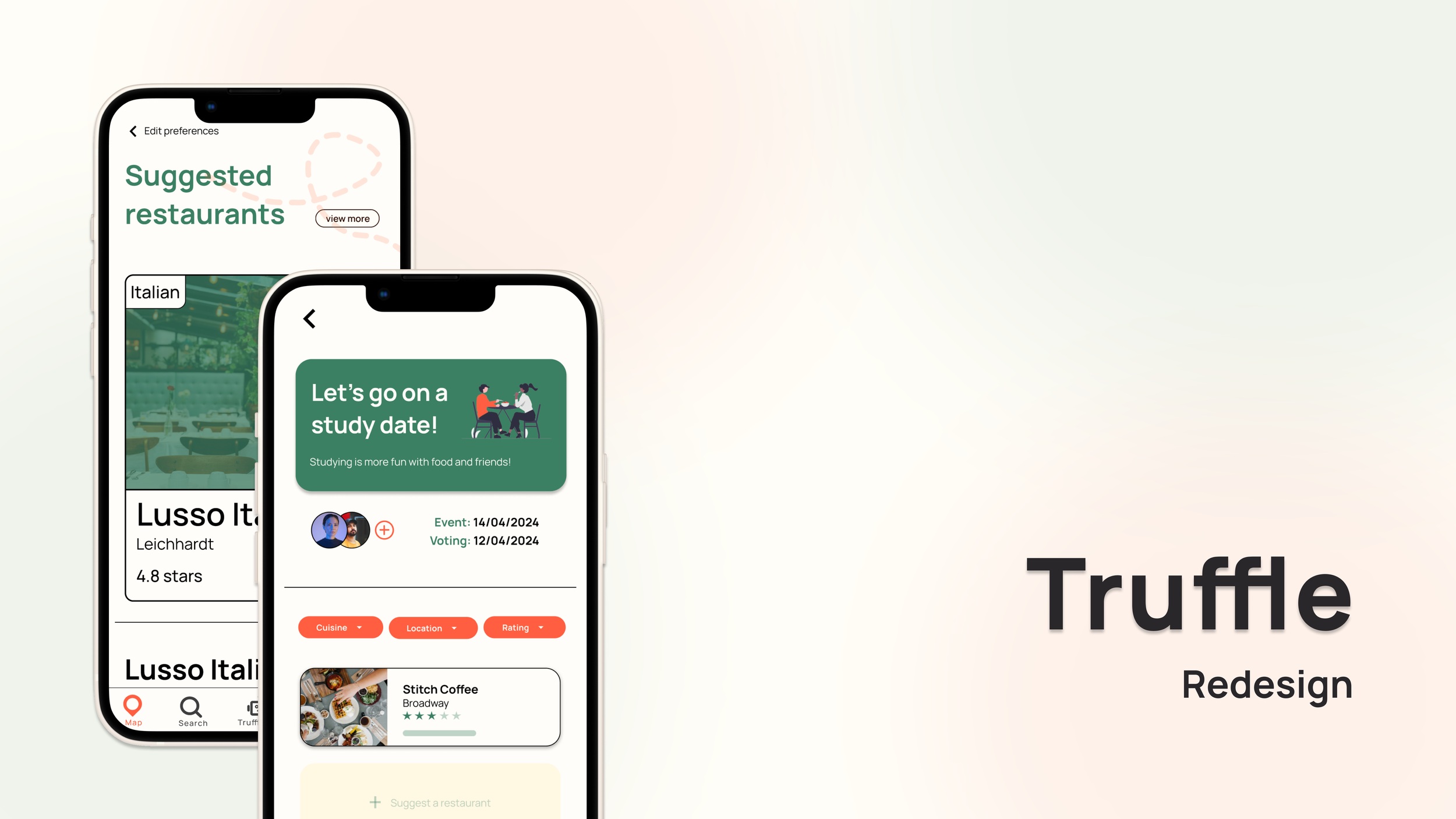
Redesigning: Truffle
Leading the product direction and research, this project explored how restaurant discovery and social dining experiences could become more collaborative and personalised. Rather than relying on fragmented sources such as social media, notes, and group chats, we reimagined Truffle as a platform that supports both individual discovery and shared decision-making.
Through user research, product strategy, and iterative design, we introduced experiences that simplified restaurant planning and reduced decision fatigue, creating a more intuitive and socially connected dining experience.
February - April
Product Manager • UX researcher • UX/UI designer
Figma • Canva
Key contributions
Product Management | Defined research goals, coordinated stakeholder sessions, and facilitated team and external meetings to align priorities and project direction.
UX Research & Insight Synthesis | Conducted mixed-method research and translated findings into problem statements, journey maps, and opportunities that informed the final experience.
Design Ownership – Shared Lists & Event Planning | Led the design of Truffle Events, introducing collaborative voting and shared experiences to simplify group dining decisions.
Supporting Contribution – Truffle Shuffle | Contributed to a personalised recommendation experience aimed at reducing decision fatigue and improving restaurant discovery.
Problem Area
Young adults often discover restaurants through fragmented sources such as social media, bookmarks, and notes. Existing food-tracking apps lack transparency, personalisation, and social connection, making recommendations difficult to organise and revisit.
User Research
Key Contributions
Research Leadership | Led a mixed-method research approach combining questionnaires (100 responses from 73 participants), contextual inquiries, and interviews to understand restaurant discovery behaviours and social dining motivations.
Insight Synthesis | Synthesised findings through affinity mapping and translated recurring themes into design opportunities around trust, social connection, and personalised discovery.
Product Strategy | Defined a revised problem statement and prioritised opportunities that balanced user value, engagement, and feasibility.

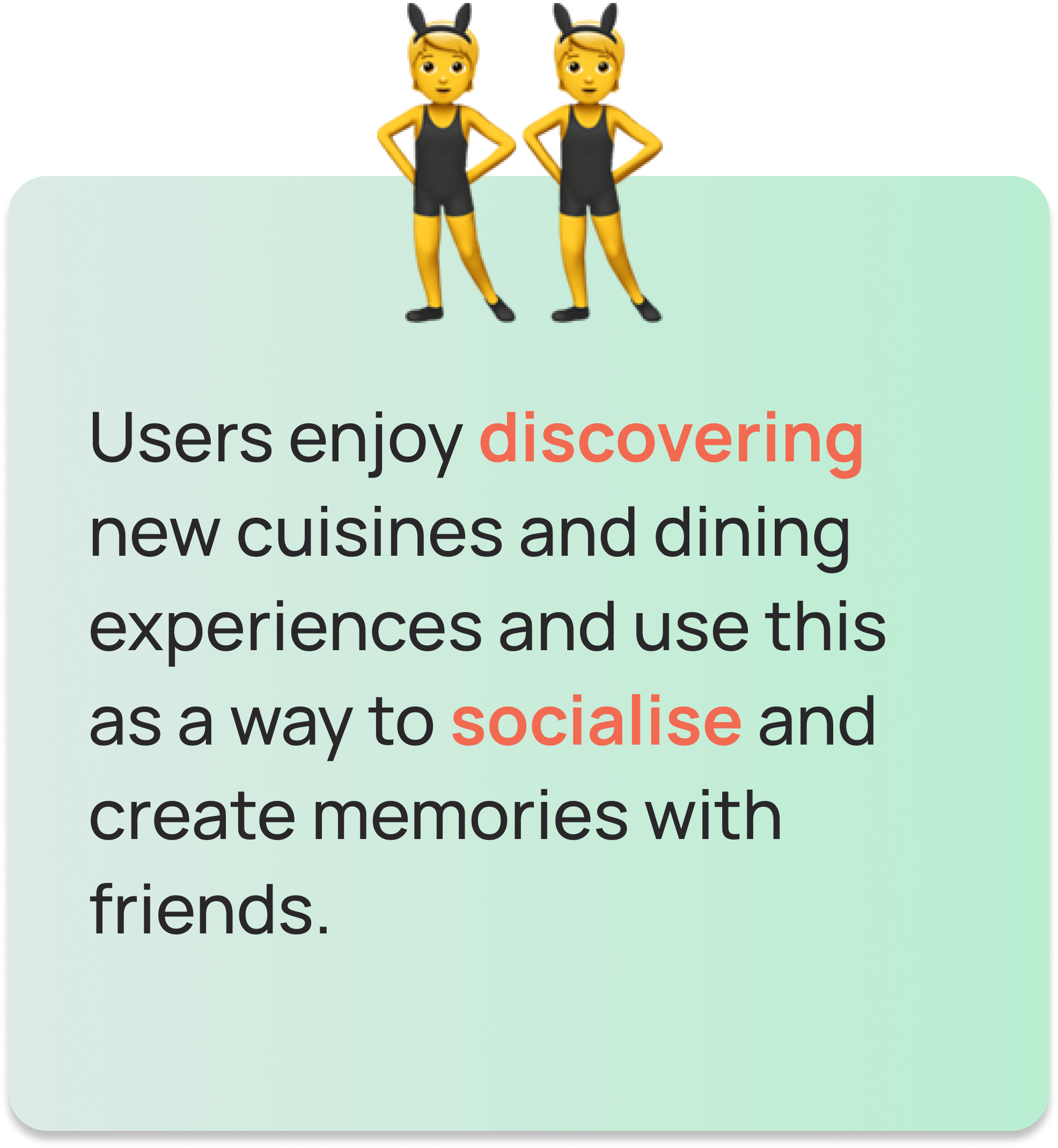
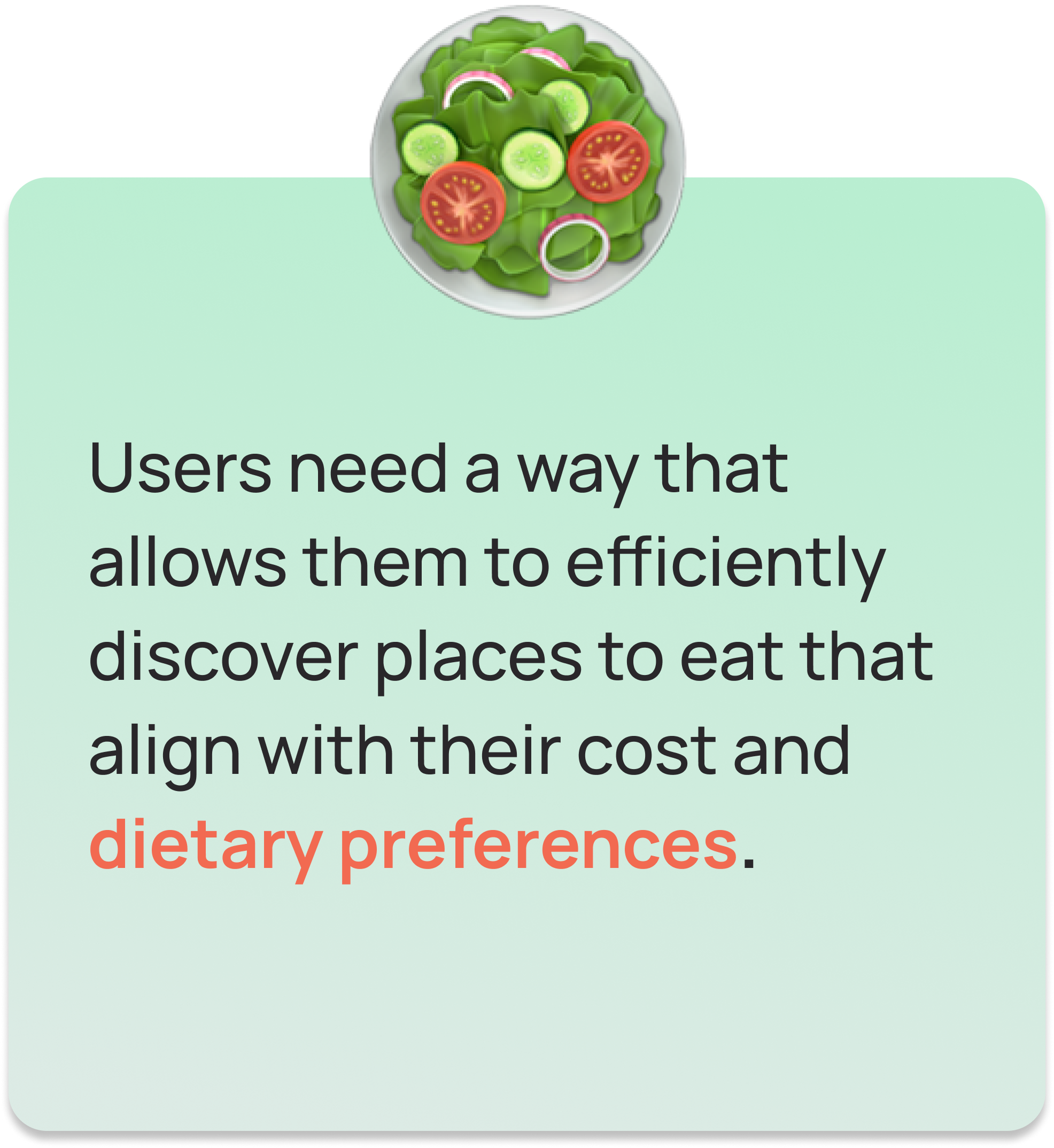
Key insights

Refined problem statement:
Young adults who value social dining experiences and trying new restaurants are disappointed by current restaurant-tracking options due to their lack of information, transparency, and convenience. These feelings are exacerbated by an unmet need for visually-driven tracking applications that not only facilitate restaurant discovery but also encourage meaningful social connections.
Ideation and User Testing
We explored concept ideation through brainstorming and Crazy 8s, generating a wide range of ideas before refining them through sketches and mockups. To ensure we selected the most effective solution, we evaluated our concepts using a decision matrix, allowing us to assess feasibility, user impact, and alignment with our research insights.


Journey Mapping
To understand how users navigate different dining scenarios, we created journey maps for both key features, revealing moments of decision fatigue and opportunities to improve collaboration and discovery. I led the journey mapping for the Shared Lists & Event Planning feature, using Henry's experience to shape the collaborative voting and event-planning experience.


Feature 1: Shared Lists & Event Planning
Design Ownership
Led the design of Shared Lists & Event Planning, creating a collaborative experience that helped groups coordinate dining decisions, reduce decision fatigue, and preserve memories beyond the meal itself.
Challenge | Users struggled to coordinate restaurant decisions with friends, often relying on fragmented group chats and facing indecision due to too many options.
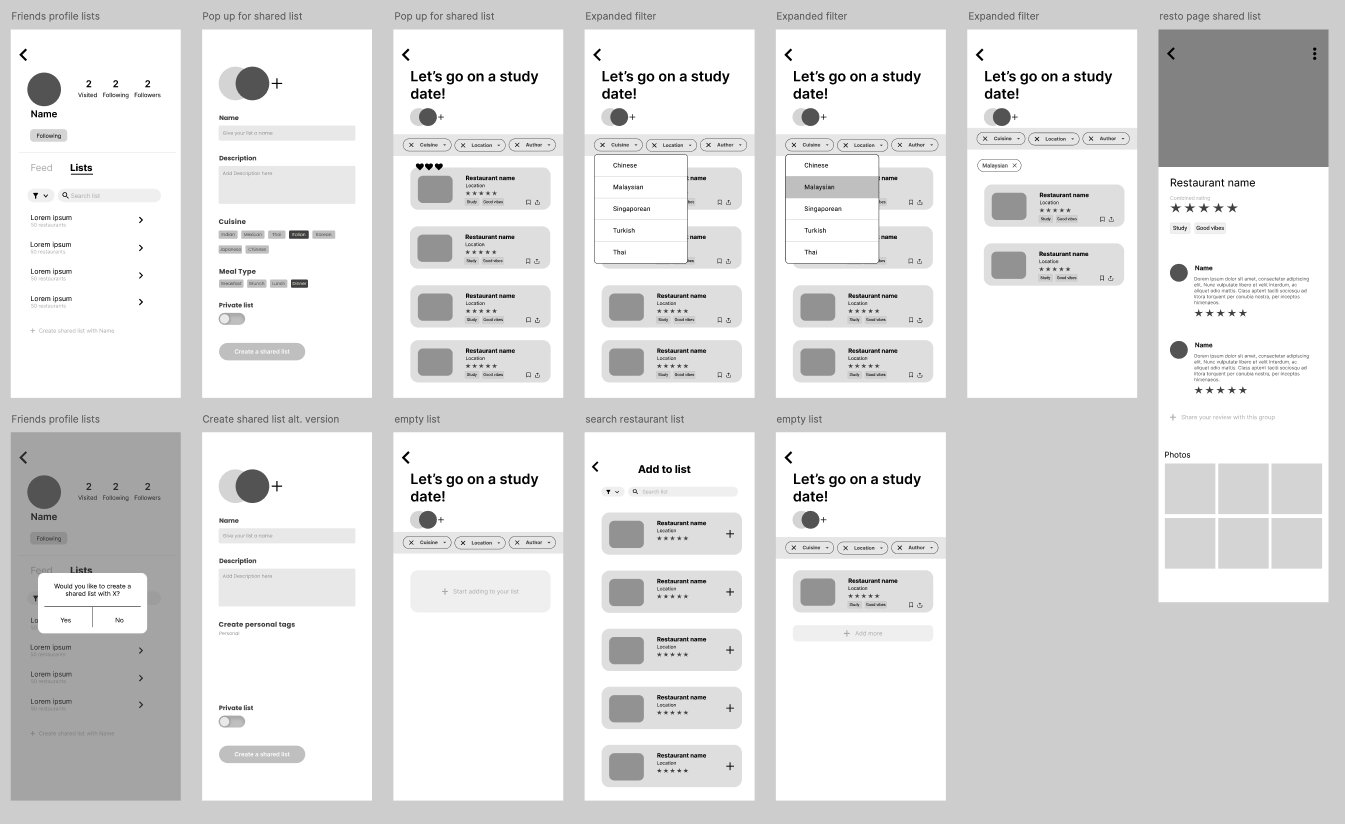
Decision | Designed a shared event flow that centralised planning, allowing users to create events, vote on restaurants, schedule meetups, and document experiences through shared photos.
Outcome | The feature transformed restaurant discovery from an individual activity into a shared social experience, supporting users before, during, and after dining.
Feature 2: Truffle Shuffle (Smart Restaurant Discovery)
Supporting Design Solution
Challenge | Users experienced decision fatigue when choosing restaurants, particularly when balancing different preferences within a group.
Decision | Our team introduced Truffle Shuffle, a recommendation experience that combined personal preferences and social context to simplify restaurant discovery and encourage shared dining experiences.
Outcome | The feature transformed restaurant selection into a more guided and collaborative process, reducing friction and helping users discover places aligned with group preferences.

Key changes
Visibility | Increased button contrast to improve discoverability.
Navigation | Replaced manual back interactions with automatic return states.
Flow | Streamlined interactions between Truffle's social and restaurant discovery features.
High-fidelity User Testing & Key Learnings
10 participants
Heuristic evaluations
SUS score: 92.1
(Carousel)
Supported by: Validated through usability testing with 10 participants, resulting in a SUS score of 92.1.
Final Prototype

Introducing: Truffle Planning

Truffle Planning High-Fidelity

Introducing: Truffle Shuffle
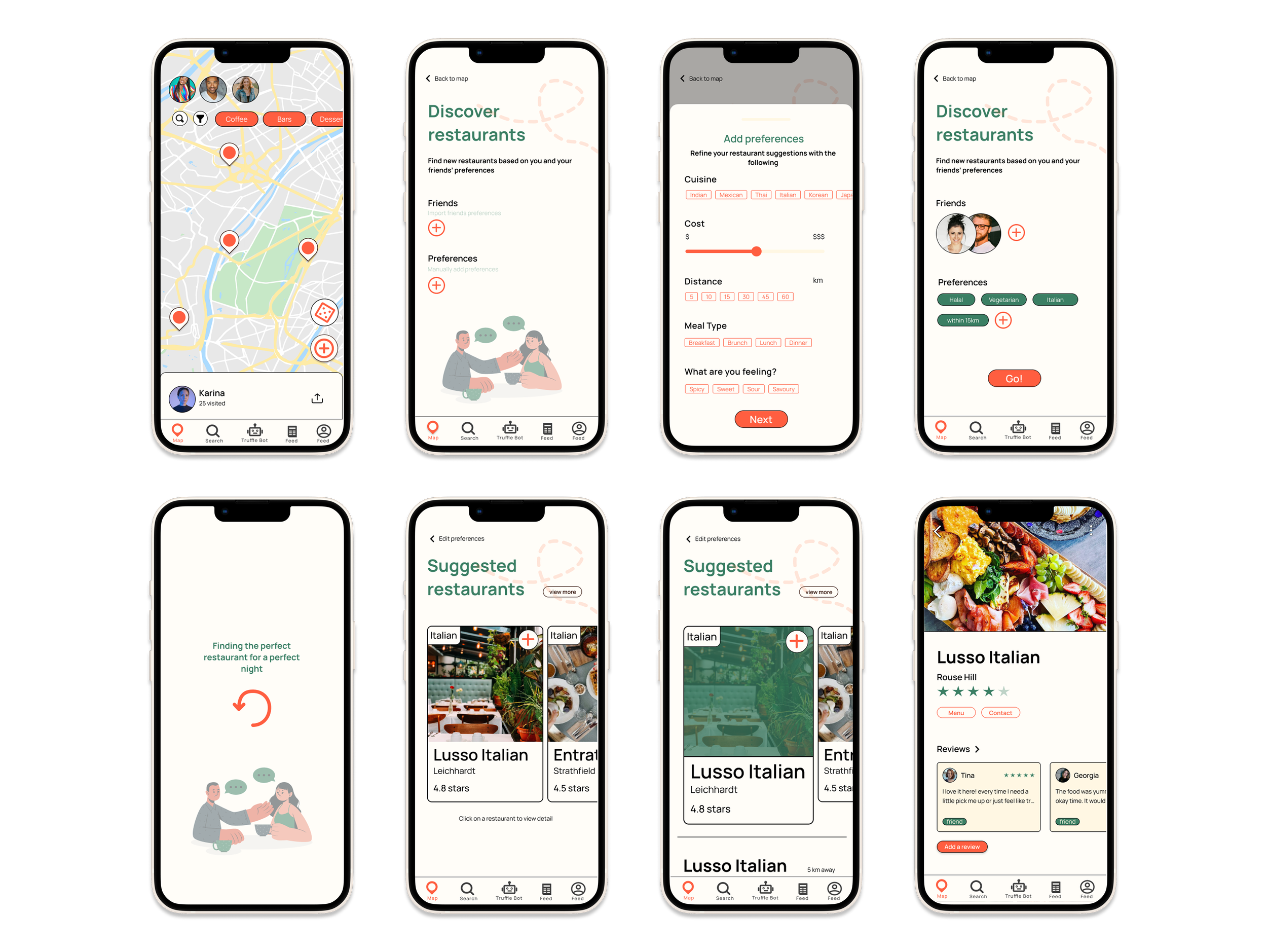
Truffle Shuffle High-Fidelity